


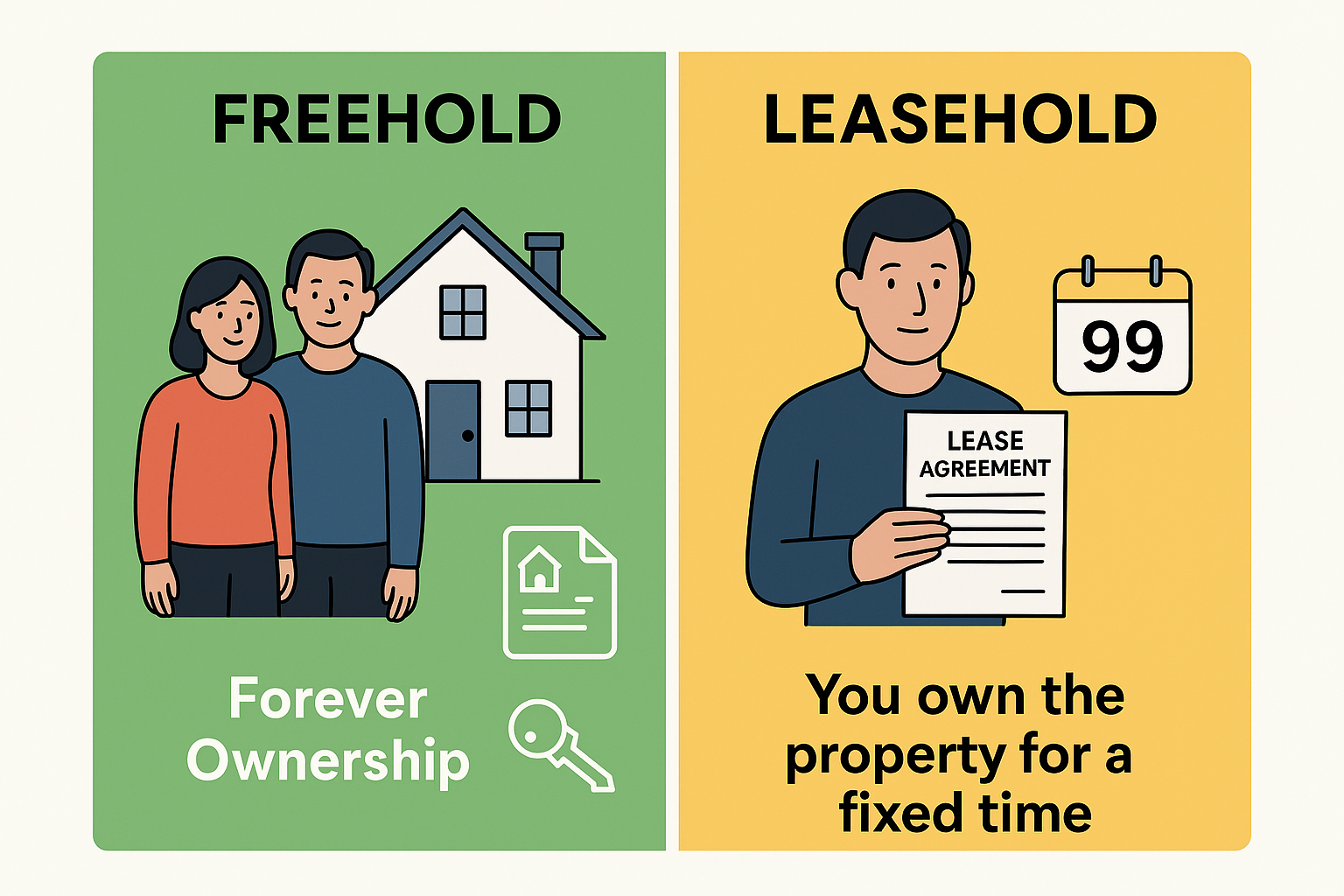
Discover the key differences between Freehold and Leasehold Property before buying. Understand ownership rights, lease duration, resale value, and which option is better for long-term investment. A simple guide to help you make a safe and smart property decision.
When buying a property, one of the biggest decisions you face is understanding whether the land is Freehold or Leasehold. Many buyers ignore this detail, but it actually affects your ownership rights, future resale value, bank loan approval, and even long-term investment growth.
This guide will help you understand both types—clearly and simply.
A Freehold property means complete ownership.
You own both the building AND the land it stands on, for unlimited time.
Full ownership without time limits
You can sell, transfer, or renovate the property as you want (subject to local laws)
Banks easily approve loans for freehold properties
Higher long-term value and appreciation
No renewal cost, no lease agreement restrictions
Long-term investors
Buyers planning to build their own house
People looking for strong resale value
Buyers who want full control over their land
A Leasehold property means you do not own the land.
Instead, you get the right to use it for a specific number of years—typically 30, 60, or 99 years.
Limited-time ownership (only for the lease period)
The land belongs to the government or a development authority
Need to renew the lease after expiry (may require cost)
Some restrictions on construction, renovation, or transfer
Banks may hesitate to give home loans if the remaining lease period is short
Buyers on a limited budget
People want a home in prime locations at a lower price
Short-term or mid-term investors
Commercial buyers who prefer affordable land costs
| Feature |
|
Leasehold Property | ||
| Ownership | Full land + building | Right to use for limited years | ||
| Tenure | Lifetime | 30–99 years | ||
| Loan Approval | Easy | Can be harder | ||
| Control | High control | Some restrictions | ||
| Resale Value | Higher | Can be lower | ||
| Cost | Higher | More affordable |
You want complete ownership
You plan to stay long-term or build your own home
You want high appreciation
You’re thinking about future generations
You want a property in a prime area for a lower price
You’re buying for a short duration
You don’t want to invest large capital up front
If your budget allows, Freehold is always the safer and stronger investment, especially in expanding areas like Delhi-NCR, Noida Extension, Ghaziabad, Gurgaon, and other fast-growing cities.
But if you’re getting a well-developed location on leasehold at a lower price, and the remaining lease is long (60+ years), it can also be a smart deal.
Land ownership documents
Lease duration (if leasehold)
Authority approvals
Bank loan eligibility
A well-informed decision today can protect your property investment for years to come.

