


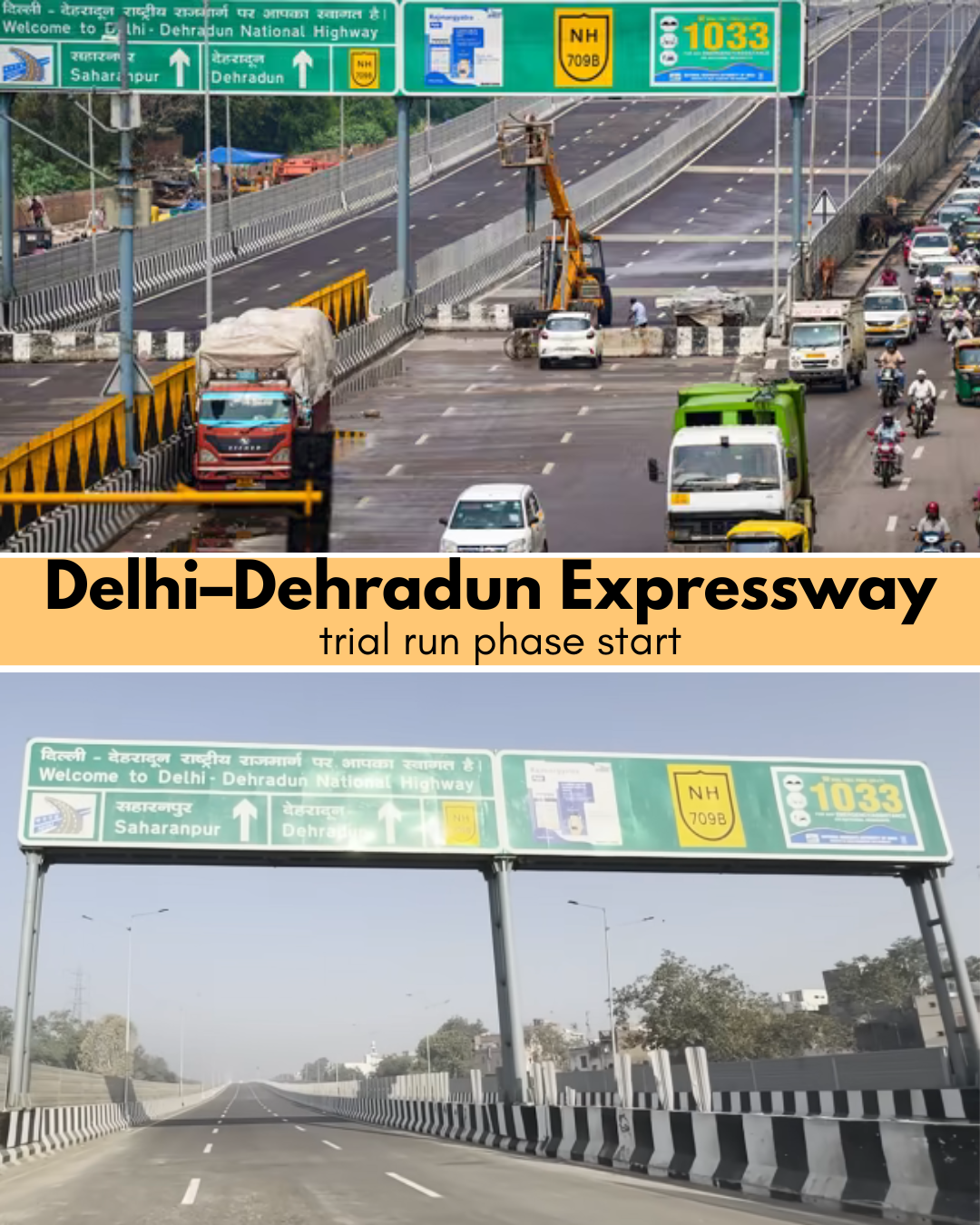
The Delhi–Dehradun Expressway Trial Run has begun, opening a 31 km stretch for commuters. Learn how this high-speed corridor will cut travel time to 2.5 hours, project details, investment, and full route updates.
The much-anticipated Delhi–Dehradun Expressway has officially entered its trial run stage, signalling a major advancement in North India’s highway modernisation. With a section of the corridor now open to the public, commuters can experience how the upcoming Delhi–Saharanpur–Dehradun Expressway will redefine travel between the capital and Uttarakhand.
Once completed, this expressway is expected to bring down the Delhi to Dehradun travel time from nearly six hours to just 2 to 2.5 hours, offering a smoother, safer, and significantly faster route.
The National Highways Authority of India (NHAI) has opened around 31–32 km of the expressway for a one-month trial run.
Key points of this segment include:
The operational stretch runs from Akshardham (Delhi) to the Eastern Peripheral Expressway near Baghpat.
No toll charges will be applied during the trial period.
Vehicles can comfortably achieve speeds up to 100 kmph on this access-controlled lane.
The trial will help evaluate traffic patterns, safety readiness, and overall road performance before the final opening.
This activated portion is part of the broader Delhi–Saharanpur–Dehradun greenfield corridor, one of India’s flagship expressway projects.
Designed to meet modern transport standards, the expressway incorporates several advanced features:
The corridor is engineered to support long-distance high-speed driving with minimal interruptions, enabling a seamless journey from Delhi to Dehradun once fully operational.
The project prioritises environmental protection with wildlife crossings, eco-bridges, and dedicated underpasses.
In addition, rainwater harvesting systems and green infrastructure ensure sustainable development throughout the route.
This expressway will significantly enhance connectivity between Delhi, Baghpat, Saharanpur, and Dehradun, boosting tourism, logistics, real-estate value, and overall regional development.
According to official updates, the entire Delhi–Saharanpur–Dehradun Expressway is expected to be ready by February 2026.
Certain bridges, tunnels, and wildlife protection structures are still under construction, and adjustments from the trial run will be incorporated before the full opening.
Once operational, the expressway will offer:
Considerably reduced travel time
A safer, controlled driving environment
Reduced congestion and smoother traffic flow
Improved access to Uttarakhand’s major tourist destinations
Economic growth opportunities for nearby regions such as Ghaziabad, Loni, Baghpat, and Saharanpur
Better movement for commercial transport and daily commuters
This infrastructure upgrade is expected to play a major role in boosting North India’s connectivity and economic activity.
The launch of the Delhi–Dehradun Expressway trial run marks a crucial milestone toward delivering one of India’s most transformative highway projects. With its modern design, focus on safety, and promise of dramatically reduced travel time, the expressway is set to reshape how people travel between Delhi and Uttarakhand.
As the project moves toward completion, travellers can look forward to a faster, more efficient route along the Delhi–Dehradun Expressway.

