


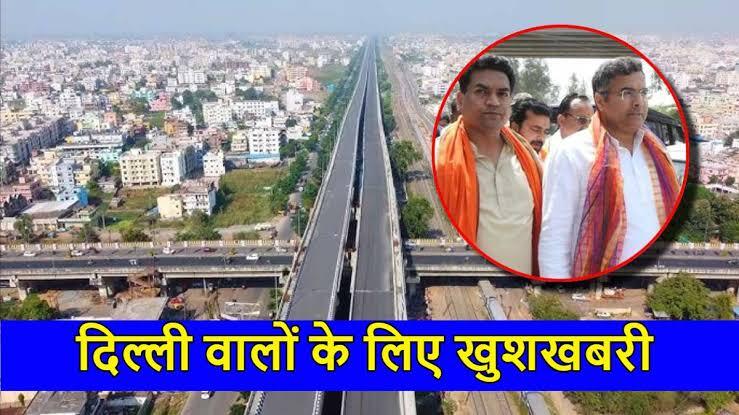
The proposed 6-km Sonia Vihar–Tronica City elevated corridor requires a revised design to address local traffic, pedestrian access and public transport facilities.
A proposed elevated road between Sonia Vihar in northeast Delhi and Tronica City near the Uttar Pradesh border has received fresh attention following concerns over its initial design. The approximately 6-km corridor is planned to improve traffic movement along Sonia Vihar Pushta Road and strengthen connectivity between Delhi and neighbouring areas of Uttar Pradesh.
However, the project has encountered a planning hurdle. In October 2026, the Unified Traffic and Transportation Infrastructure (Planning and Engineering) Centre (UTTIPEC) raised objections to the initial design submitted by Delhi’s Public Works Department (PWD). The department has been asked to revise the proposal to better accommodate local traffic, pedestrians, cyclists and public transport users.
The development is important for commuters travelling between northeast Delhi, Loni and Tronica City, although the final benefits will depend on the revised design and the project's eventual implementation.
The proposed elevated corridor is intended to address congestion on a busy road connecting northeast Delhi with the Delhi–Uttar Pradesh border.
Here are the key details reported so far:
| Project Detail | Information |
|---|---|
| Project name | Sonia Vihar–Tronica City Elevated Road |
| Proposed length | Approximately 5.5–6 km |
| Estimated cost | Around ?500 crore |
| Starting point | Nanaksar Gurdwara T-point, Sonia Vihar |
| Proposed endpoint | Delhi–Uttar Pradesh border near Tronica City |
| Implementing department | Public Works Department, Delhi |
| Main objective | Reduce traffic congestion and improve connectivity |
| Latest reported status | Initial design requires revision |
The length and cost figures relate to the initial proposal. The final design, approvals, budget and construction timeline may change as the planning process progresses.
Sonia Vihar Pushta Road is an important route for commuters travelling through northeast Delhi towards the Uttar Pradesh border. Traffic congestion, limited road space, roadside activity and pedestrian movement have contributed to pressure on this stretch.
Expanding an existing road can be difficult in densely populated areas, particularly where buildings, trees, utilities and local markets restrict the available space.
The proposed elevated corridor aims to provide additional road capacity without relying entirely on widening the existing road at ground level. It is also intended to improve movement between Sonia Vihar and the Tronica City border area.
However, building an elevated road alone may not resolve every traffic problem. Connections with surrounding roads, junction design and facilities for local residents will also play an important role.
The latest major development was reported on October 29–30, 2026, when UTTIPEC raised concerns about the initial proposal prepared by PWD.
According to reports published by The Tribune and Jagran, the design focused heavily on moving traffic between Delhi and Uttar Pradesh but did not adequately address the requirements of people living and travelling along the route.
The concerns included:
Safe and convenient pedestrian movement
Footpaths and cycle lanes
Proper entry and exit points
Suitable bus stop locations
Better-designed road junctions
Safe arrangements for pedestrians crossing the road
UTTIPEC asked PWD to prepare a revised design that considers both elevated traffic movement and the needs of people using the road below.
The objection does not mean the project has necessarily been cancelled. It means the proposed design needs further work before the project can progress in its intended form.
The next version of the proposal is expected to address several aspects of local road planning.
People walking along Sonia Vihar Pushta Road need safe and accessible pedestrian facilities. Footpaths beneath the elevated structure could help improve movement for residents, shoppers and other road users.
The revised proposal has been asked to consider cycle lanes and other non-motorised transport facilities. These provisions are important in areas where many short journeys take place on foot or by bicycle.
Public transport access is another important consideration. Suitable bus stop locations could make it easier for passengers to board and leave buses without creating unnecessary traffic conflicts.
The locations of entry and exit points will influence how effectively the elevated corridor connects with the surrounding road network. Poorly planned access could create bottlenecks instead of reducing congestion.
The revised design must also consider how vehicles will move through intersections and how pedestrians can cross the road safely.
These features will be important in ensuring that the project serves local residents as well as commuters travelling through the area.
If the project moves forward and is implemented effectively, it could improve connectivity along the Sonia Vihar–Tronica City route.
Areas mentioned in reports about the proposed corridor include:
Sonia Vihar Pushta-1
Sri Ram Colony
Chautha Pushta
Sonia Vihar Extension
Sabhapur
Chauhan Patti
Tronica City and nearby areas along the Delhi–Uttar Pradesh border
The extent of the benefits will depend on the final alignment, access points, junction improvements and connections with existing roads.
The project should therefore be viewed as a proposed connectivity improvement rather than a guarantee of specific travel-time savings for every locality.
Loni and Tronica City are located close to the Delhi border, making road connectivity an important consideration for residents, commuters and businesses.
A well-connected elevated corridor between Sonia Vihar and the Tronica City border could offer an additional route for some journeys between northeast Delhi and neighbouring Uttar Pradesh areas.
For industrial areas and residential neighbourhoods, reliable road access can be important for commuting, goods movement and access to services.
However, the actual impact will depend on how the elevated road connects with the existing road network. Local entry and exit points, traffic junctions and ground-level facilities will all influence whether the corridor delivers practical benefits to nearby communities.
At this stage, there is not enough confirmed information to quantify future travel-time savings or predict a specific change in property prices.
As of the latest reports published on October 29–30, 2026, the project remains at the design and planning stage following objections to the initial proposal.
The corridor was previously announced as a proposed project with an estimated cost of ?500 crore. The latest development concerns the need to revise the design to address local traffic and pedestrian requirements.
A project announcement, design approval, tendering process and actual construction are separate stages. Therefore, the reported project cost and proposed route should not be interpreted as confirmation that construction has begun.
The next important development to watch is whether PWD submits a revised design that addresses the concerns raised by UTTIPEC and what decisions follow.
The proposed elevated corridor is significant because it aims to address both regional traffic movement and congestion on a heavily used local route.
First, it could provide additional road capacity between Sonia Vihar and the Delhi–Uttar Pradesh border.
Second, it could improve connectivity towards Tronica City for some commuters travelling from northeast Delhi.
Third, the revised design provides an opportunity to incorporate better pedestrian access, cycle lanes, bus stops and road crossings into the project.
These improvements will be important because a road infrastructure project needs to serve both through traffic and the people who live, work and travel along the route.
The success of the project will ultimately depend on the approved design, implementation and integration with the existing transport network.
The proposed corridor is approximately 5.5–6 kilometres long. It is planned to connect the Nanaksar Gurdwara T-point in Sonia Vihar with the Delhi–Uttar Pradesh border near Tronica City.
The initial estimated cost is around ?500 crore. The final cost may change depending on the revised design, approvals and implementation requirements.
UTTIPEC raised concerns that the initial design did not adequately address local traffic, pedestrian crossings, footpaths, cycle lanes, bus stops and access arrangements. PWD has been asked to prepare a revised proposal.
Reducing congestion is one of the project's main objectives. However, the actual impact will depend on the final design, the quality of connecting roads and the arrangements for local traffic.
The latest reports from late October 2026 describe the project as being at the design revision stage. A confirmed construction start date has not been established by these reports.
The proposed corridor aims to improve connectivity towards Tronica City and the Delhi–Uttar Pradesh border. The extent of the benefit for Loni and surrounding areas will depend on the final route and connections with existing roads.
The proposed Sonia Vihar to Tronica City elevated road is an important infrastructure plan for northeast Delhi and the adjoining Uttar Pradesh border region. With an estimated cost of ?500 crore and a planned length of approximately 6 kilometres, the project aims to improve traffic movement and strengthen regional connectivity.
The latest development is the requirement to revise the initial design to better accommodate pedestrians, cyclists, public transport users and local traffic.
For residents and commuters travelling between Delhi, Loni and Tronica City, the key point to watch is the revised proposal and the decisions that follow. Until further official updates are available, the corridor should be treated as a proposed project rather than an operational or under-construction road.

